Download Oracle Vm Virtualbox Extension For 4.2.24
 VirtualBox logo since 2010 | |
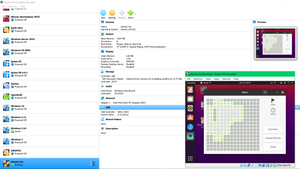 Running Ubuntu 20.x with Oracle VM VirtualBox on Windows ten | |
| Original author(s) | Innotek |
|---|---|
| Programmer(south) | Oracle Corporation |
| Initial release | 17 Jan 2007 (2007-01-17) |
| Stable release | 6.1.32[ane] |
| Repository |
|
| Written in | C, C++, x86 Assembly, Python |
| Operating system | Windows, macOS (only Intel-based Macs), Linux and Solaris[two] |
| Platform | x86-64 only (version series 5.x and earlier work on IA-32)[3] |
| Blazon | Hypervisor |
| License | Base Package (USB support only for USB one.1): GNU General Public License version 2 (Optionally CDDL for near files of the source distribution), "Extension Pack" (including USB three.0 support): PUEL |
| Website | www |
Oracle VM VirtualBox (formerly Sun VirtualBox, Sun xVM VirtualBox and Innotek VirtualBox) is a blazon-2 hypervisor for x86 virtualization developed by Oracle Corporation.
VirtualBox was originally created by Innotek GmbH, which was acquired by Dominicus Microsystems in 2008, which was in turn acquired by Oracle in 2010.
VirtualBox may be installed on Microsoft Windows, macOS, Linux, Solaris and OpenSolaris. There are likewise ports to FreeBSD[4] and Genode.[5] It supports the creation and management of guest virtual machines running Windows, Linux, BSD, OS/2, Solaris, Haiku, and OSx86,[6] also as limited virtualization of macOS guests on Apple hardware.[7] [8] For some guest operating systems, a "Guest Additions" package of device drivers and arrangement applications is available,[ix] [10] which typically improves performance, especially that of graphics, and allows changing the resolution of the invitee Os automatically when the window of the virtual machine on the host OS is resized.[11]
Released under the terms of the GNU Full general Public License and, optionally, the CDDL for about files of the source distribution, VirtualBox is costless and open-source software, though the Extension Pack is proprietary software.
History [edit]

Logo of VirtualBox OSE, 2007–2010
VirtualBox was first offered by Innotek GmbH from Weinstadt, Germany, under a proprietary software license, making ane version of the product available at no toll for personal or evaluation use, subject to the VirtualBox Personal Use and Evaluation License (PUEL).[12] In Jan 2007, based on counsel by LiSoG, Innotek GmbH released VirtualBox Open Source Edition (OSE) as gratis and open-source software, subject to the requirements of the GNU General Public License (GPL), version two.[13]
Innotek GmbH as well contributed to the development of Bone/two and Linux back up in virtualization[fourteen] and OS/two ports[15] of products from Connectix which were afterwards caused by Microsoft. Specifically, Innotek developed the "additions" code in both Windows Virtual PC and Microsoft Virtual Server, which enables various host–invitee OS interactions like shared clipboards or dynamic viewport resizing.
Sun Microsystems acquired Innotek in February 2008.[xvi] [17] [18]
Following the acquisition of Sunday Microsystems past Oracle Corporation in January 2010, the product was re-branded every bit "Oracle VM VirtualBox".[19] [20] [21]
In December 2019, VirtualBox started supporting simply hardware-assisted virtualization, dropping support for Software-based i.[22] [2]
Release history [edit]
- Version 3.ii
- Mac Os X Server invitee back up – experimental
- Retentiveness ballooning (not bachelor on Solaris hosts)
- RAM deduplication (Page Fusion) for Windows guests on 64-bit hosts
- CPU hot-plugging for Linux (hot-add and hot-remove) and certain Windows guests (hot-add merely)
- Deleting snapshots while the VM is running
- Multi-monitor guest setups in the GUI, for Windows guests
- LSI Logic SAS controller emulation
- Remote Desktop Protocol (RDP) video acceleration via a non-free extension
- Run and control guest applications from the host – for automated software deployments
- Version 4.0
- The PUEL/OSE separation was abandoned in favor of an open source base of operations production and a closed source extension pack that tin can be installed on top of the base product. Equally part of this change, additional components of VirtualBox were fabricated open source (installers, documentation, device drivers)
- Intel Hd sound codec emulation
- Intel ICH9 chipset emulation
- A new VM storage scheme where all VM data is stored in one unmarried binder to ameliorate VM portability
- Several UI enhancements including a new look with VM preview and scale fashion
- On 32-fleck hosts, VMs can each use more than ane.5 GB of RAM
- In addition to OVF, the single file OVA format is supported
- CPU use and I/O bandwidth tin be limited per VM
- Back up for Apple DMG images (DVD)
- Multi-monitor guest setups for Linux/Solaris guests (previously Windows only)
- Resizing of disk image formats from Oracle, VDI (VirtualBox disk image), and Microsoft, VHD (Virtual PC hard disk)
- Version four.one
- Windows Aero back up (experimental)
- Virtual machine cloning
- Version 4.two
- Virtual auto groups – allows management of a group of virtual machines as a single unit (power them on or off, accept snapshots, etc.)
- Some VM settings can be contradistinct during VM execution
- Support upward to 36 NICs in instance of the ICH9 chipset
- Support for limiting network I/O bandwidth
- Can automatically run VMs on host system startup (except on Windows hosts)
- Version 4.three
- VM video-capture support
- Host touch device back up (GUI passes host impact events to guest)/USB virtualization of such devices
- Version 5.0[23]
- Paravirtualization support for Windows and Linux guests to improve time-keeping accurateness and performance
- USB3 controller based on Intel's hardware implementation.[24] It is supported by any Windows version starting from Windows 8, whatever Linux kernel starting from 2.six.31 and Mac OS X starting from version 10.seven.4.[ citation needed ]
- Bidirectional elevate and drop support for Windows, Linux and Solaris guests
- VM disk image encryption via a not-free extension
- VM output scaling and HiDPI displays support
- Hotplugging of SATA disks using GUI
- USB traffic capturing
- VMs can be disconnected from a GUI session and run in groundwork[25]
- AVX, AVX-2, AES-NI, SSE 4.1/4.two instructions (if supported by the host CPU)
- Version vi.0[26]
- Support for exporting virtual machines to Oracle Deject
- A file director which allows to control the guest file organisation and copy files from/to it
- VMSVGA GPU driver for Linux hosts
- Environment speakers setup support
- Support for hardware-assisted nested virtualization on AMD CPUs
- Version 6.i[22]
- Back up for importing virtual machines from Oracle Cloud
- Added nested virtualization support for Intel CPUs (it was already bachelor for AMD CPUs) starting with Intel Core i5 Broadwell
- Experimental back up for file transfers via drag-n-drop just for Windows host and guests (disabled by default, must be enabled using VBoxManage)
- Support for virtio-scsi for hard disks and optical drives, including kick support
- Back up for hosts with up to 1024 CPUs
- DXVA (hardware accelerated video decoding) back up for Windows guests
- NVRAM support for EFI which improves compatibility with many guest OSes
- Software keyboard for inbound any keys to a guest
- Invitee CPU utilise monitoring
- Dropped support for software CPU virtualization: a CPU with hardware virtualization support is now required
- Dropped support for PCI passthrough for Linux hosts
- Soft (virtual) keyboard
- Version 7.0 (in development)
- Secure Boot support for guest operating systems[27]
- TPM ii.0 module
Virtualization [edit]
Users of VirtualBox can load multiple invitee OSes under a single host operating-organization (host Os). Each guest can be started, paused and stopped independently within its own virtual machine (VM). The user tin independently configure each VM and run it nether a pick of software-based virtualization or hardware assisted virtualization if the underlying host hardware supports this. The host OS and guest OSs and applications tin communicate with each other through a number of mechanisms including a common clipboard and a virtualized network facility. Guest VMs can also direct communicate with each other if configured to do so.[28]
Hardware-assisted [edit]
VirtualBox supports both Intel'southward VT-ten and AMD'southward AMD-V hardware-assisted virtualization. Making utilise of these facilities, VirtualBox can run each guest VM in its own separate accost-space; the invitee Bone ring 0 code runs on the host at ring 0 in VMX non-root style rather than in band 1.[ citation needed ]
Starting with version vi.one, VirtualBox simply supports this method.[22] [2] Until then, VirtualBox specifically supported some guests (including 64-flake guests, SMP guests and certain proprietary OSs) only on hosts with hardware-assisted virtualization.[ citation needed ]
Devices and peripherals [edit]
VirtualBox emulates difficult disks in three formats: the native VDI (Virtual Deejay Image),[29] the VMDK of VMware and the VHD of Microsoft Windows. It thus supports disks created by other hypervisor software. VirtualBox tin can besides connect to iSCSI targets and to raw partitions on the host, using either equally virtual hard disks. VirtualBox emulates IDE (PIIX4 and ICH6 controllers), SCSI, SATA (ICH8M controller) and SAS controllers to which hard drives tin be fastened.
VirtualBox has supported Open Virtualization Format (OVF) since version 2.two.0 (April 2009).[30]
Both ISO images and physical devices continued to the host can be mounted as CD or DVD drives. VirtualBox supports running operating systems from live CDs and DVDs.
By default, VirtualBox provides graphics back up through a custom virtual graphics-card that is VBE or UEFI GOP uniform. The Invitee Additions for Windows, Linux, Solaris, OpenSolaris, or Os/two guests include a special video-commuter that increases video performance and includes boosted features, such as automatically adjusting the invitee resolution when resizing the VM window[31] or desktop composition via virtualized WDDM drivers .
For an Ethernet network adapter, VirtualBox virtualizes these Network Interface Cards:[32]
- AMD PCnet PCI Ii (Am79C970A)
- AMD PCnet-Fast 3 (Am79C973)
- Intel Pro/1000 MT Desktop (82540EM)
- Intel Pro/1000 MT Server (82545EM)
- Intel Pro/yard T Server (82543GC)
- Paravirtualized network adapter (virtio-net)
The emulated network cards let most invitee OSs to run without the need to detect and install drivers for networking hardware as they are shipped as part of the guest Os. A special paravirtualized network adapter is also available, which improves network performance by eliminating the need to match a specific hardware interface, but requires special driver support in the guest. (Many distributions of Linux ship with this driver included.) By default, VirtualBox uses NAT through which Internet software for end-users such as Firefox or ssh tin can operate. Bridged networking via a host network adapter or virtual networks between guests can also be configured. Up to 36 network adapters can be attached simultaneously, but only four are configurable through the graphical interface.
For a audio carte, VirtualBox virtualizes Intel Hard disk Audio, Intel ICH AC'97 and SoundBlaster 16 devices.[33]
A USB one.1 controller is emulated and so that any USB devices fastened to the host can be seen in the guest. The proprietary extension pack adds a USB 2.0 or USB three.0 controllers and, if VirtualBox acts equally an RDP server, it can likewise employ USB devices on the remote RDP customer as if they were connected to the host, although merely if the customer supports this VirtualBox-specific extension (Oracle provides clients for Solaris, Linux and Sun Ray sparse clients that tin do this, and take promised support for other platforms in future versions).[34]
Software-based [edit]
In the absence of hardware-assisted virtualization, versions vi.0 and earlier of VirtualBox could prefer a standard software-based virtualization approach. This style supports 32-bit guest OSs which run in rings 0 and 3 of the Intel band architecture.
- The system reconfigures the guest OS code, which would unremarkably run in ring 0, to execute in ring one on the host hardware. Because this code contains many privileged instructions which cannot run natively in band 1, VirtualBox employs a Code Scanning and Assay Director (CSAM) to browse the ring 0 code recursively before its first execution to identify problematic instructions and and so calls the Patch Manager (PATM) to perform in-situ patching. This replaces the pedagogy with a leap to a VM-safe equivalent compiled code fragment in hypervisor memory.
- The invitee user-style code, running in ring three, by and large runs directly on the host hardware in ring three.
In both cases, VirtualBox uses CSAM and PATM to inspect and patch the offending instructions whenever a mistake occurs. VirtualBox also contains a dynamic recompiler, based on QEMU to recompile whatever real mode or protected style lawmaking entirely (e.yard. BIOS code, a DOS guest, or any operating system startup).[35]
Using these techniques, VirtualBox can accomplish a functioning comparable to that of VMware.[36] [37]
The feature was dropped starting with VirtualBox 6.i.[22] [two]
Features [edit]
- Snapshots of the RAM and storage that allow reverting to a prior country.
- Screenshots and screen video capture
- "Host primal" for releasing the keyboard and mouse cursor to the host system if captured (coupled) to the guest system, and for keyboard shortcuts to features such equally configuration, restarting, and screenshot. By default, it is the right-side CTRL key.[38] [39]
- Mouse pointer integration, meaning automated coupling and uncoupling of mouse cursor when moved inside and exterior the virtual screen, if supported by invitee operating arrangement.
- Seamless mode – the ability to run virtualized applications side by side with normal desktop applications
- Shared clipboard
- Shared folders through "guest additions" software[forty]
- Special drivers and utilities to facilitate switching between systems
- Ability to specify amount of shared RAM, video retentivity, and CPU execution cap
- Ability to emulate multiple screens[41]
- Command line interaction (in improver to the GUI)
- Public API (Java, Python, Soap, XPCOM) to control VM configuration and execution[42]
- Nested paging for AMD-V and Intel VT (only for processors supporting SLAT and with SLAT enabled)
- Limited support for 3D graphics acceleration (including OpenGL up to (but not including) 3.0 and Direct3D ix.0c via Vino'southward Direct3D to OpenGL translation)
- SMP support (up to 32 virtual CPUs per virtual machine), since version 3.0
- Teleportation (aka Live Migration)
- 2D video output acceleration (non to be mistaken with video decoding acceleration), since version 3.1
- EFI has been supported since version three.ane (Windows seven[43] [44] guests are not supported)[45]
Storage emulation [edit]
- Ability to mount virtual hard deejay drives and disk images. Virtual optical disc images can exist used for booting and sharing files to invitee systems lacking networking support.
- NCQ back up for SATA, SCSI and SAS raw disks and partitions
- SATA disk hotplugging
- Pass-through mode for solid-state drives
- Pass-through fashion for CD/DVD/BD drives – allows users to play audio CDs, burn optical disks, and play encrypted DVD discs
- Can disable host Os I/O cache
- Allows limitation of IO bandwidth
- PATA, SATA, SCSI, SAS, iSCSI, floppy deejay controllers
- VM disk image encryption using AES128/AES256
Storage support includes:
- Raw difficult deejay access – allows concrete hard disk partitions on the host system to appear in the invitee system
- VMware Virtual Automobile Deejay (VMDK) format support – allows exchange of deejay images with VMware
- Microsoft VHD back up
- QEMU qed and qcow disks
- HDD format disks (just version 2; versions three and 4 are not supported) used past Parallels virtualization products
Limitations [edit]
- 3D graphics dispatch for Windows guests earlier than Windows 7 [46] was removed in version 6.1.[47] This affected Windows XP [48] and Windows Vista.
- VirtualBox has a very low transfer rate to and from USB2 devices.[49] [50]
- Despite being an open up source production, some of its features are available only in a binary course under a commercial license (see "VirtualBox Extension Pack" below).
- No cumulative measurement of disk reading and writing like in Microsoft Virtual PC.
- USB3 devices pass through is not supported by older invitee OSes like Windows Vista and Windows XP due to the lack of drivers all the same starting with version 5.0 VirtualBox offers experimental Renesas uPD720201 xHCI USB3 controller which allows to use USB3 in these operating systems through manual modification of configuration files.[51] [52]
- Guest Additions for macOS are unavailable at this time.[53]
- Guest Additions for Windows 9x (Windows 95, 98 and ME) are not available. This results in poor operation due to the lack of graphics acceleration with the default sixteen-fleck color mode (external third-party software is available[54] [55] [56] to enable support for 32-fleck color mode, resulting in better functioning).[57] [58] [59]
- EFI back up is incomplete, eastward.g. EFI kick for a Windows 7 guest is not supported.[53] [45]
- Only older versions of DirectX and OpenGL passthrough are supported (the characteristic tin be enabled using the 3D Acceleration option for each VM individually).[60]
- Video RAM is limited to 128 MiB (256 MiB with 2D Video Acceleration enabled) due to technical difficulties[61] (merely irresolute the GUI to allow the user to allocate more video RAM to a VM or manually editing the configuration file of a VM won't work and volition effect in a fatal mistake[61]).
- Windows 95/98/98SE/ME cannot be installed or work unreliably with modern CPUs (AMD Zen or newer) and hardware assisted virtualization (VirtualBox vi.one and higher). This is due to these OSes not being coded correctly.[62] [63] [64]
- VirtualBox 7.0 (currently available as a evolution snapshot[65]) and later is required to run a pristine Windows 11 invitee.[27]
Host back up [edit]
The supported operating systems include:[66]
- Windows viii.one and higher. Support for 64-fleck Windows was added with VirtualBox 1.5. Support for Windows XP was removed with VirtualBox 5.0. Support for Windows Vista was removed with VirtualBox five.ii. Windows 7 support was removed in version six.1.
- Windows Server 2012 and higher
- Linux distributions
- macOS from version 10.13 High Sierra to ten.15 Catalina (only on Intel-based Macs):
- Preliminary Mac OS 10 back up (beta stage) was added with VirtualBox 1.iv, full back up with 1.6.
- Mac Bone 10 10.4 (Tiger) support was removed with VirtualBox three.1.
- Back up for Mac OS Ten x.7 (Lion) and before was removed with VirtualBox 5.0.
- Support for Mac Os X 10.8 (Mount Lion) was removed with VirtualBox 5.one.
- Support for Mac OS X 10.ix (Mavericks) was removed with VirtualBox v.2. "VirtualBox Transmission (Archived)". Archived from the original on 2018-12-17.
- Support for (Mac) Os X 10.10 Yosemite and OS X 10.11 El Capitan was removed with VirtualBox 6.0.
- Support for macOS ten.12 Sierra was officially removed with VirtualBox vi.i (every bit of half dozen.1.16 information technology will yet install and run, however) [66]
- No support of macOS 11 Big Sur and later on versions is officially provided. Users reported various technical issues when running VirtualBox on macOS Big Sur.[67]
- Because VirtualBox is an x86 virtualization software, it is not available, and is not planned to be, for Apple silicon-based Macs.[68]
- Oracle Solaris
Guests [edit]
Some features crave the installation of the closed-source "VirtualBox Extension Pack":[ii]
- Support for a virtual USB two.0/3.0 controller (EHCI/xHCI)
- VirtualBox RDP: back up for the proprietary remote connectedness protocol adult by Microsoft and Citrix Systems.
- PXE kick for Intel cards.
- VM deejay image encryption
- Camera / webcam back up[69]
While VirtualBox itself is gratis to apply and is distributed under an open source license the VirtualBox Extension Pack is licensed under the VirtualBox Personal Use and Evaluation License (PUEL). Personal employ is free just commercial users need to buy a license. Oracle routinely checks log files for downloads of the VirtualBox Extension Pack from nonresidential IP addresses and contacts unlicensed users to enforce compliance.[lxx] [ failed verification ]
While Invitee Additions are installed within each suitable guest virtual machine, the Extension Pack is installed on the host running VirtualBox.
Licensing [edit]
The core package is, since version 4 in December 2010, free software under GNU General Public License version 2 (GPLv2). The divide "VirtualBox Oracle VM VirtualBox extension pack" providing back up for USB ii.0 and 3.0 devices, Remote Desktop Protocol (RDP), disk encryption, NVMe and Preboot Execution Environment (PXE) boot is under a proprietary license, called Personal Use and Evaluation License (PUEL), which permits utilize of the software for personal employ, educational use, or evaluation, free of charge.[71] Since VirtualBox version 5.i.30[72] Oracle defines personal use equally the installation of the software on a unmarried host estimator for non-commercial purposes.[73] Unlike some software using a proprietary license, the "VirtualBox Oracle VM VirtualBox extension pack" is not source-available since it includes airtight-source components, which does not make the source code publicly available.[74]
Prior to version 4, at that place were two unlike packages of the VirtualBox software. The full package was offered gratis under the PUEL, with licenses for other commercial deployment purchasable from Oracle. A 2nd parcel called the VirtualBox Open Source Edition (OSE) was released under GPLv2. This removed the same proprietary components not available under GPLv2.[73] [74]
Building the BIOS for VirtualBox since version 4.2 [ citation needed ] requires the employ of the Open Watcom compiler,[75] for which the Sybase Open Watcom Public License is canonical as "Open Source" by the Open Source Initiative[76] just not equally "costless" by the Free Software Foundation or under the Debian Gratuitous Software Guidelines.[75] [77]
Although VirtualBox has experimental back up for macOS guests, the end user license understanding of macOS does non permit the operating system to run on non-Apple hardware, and this is enforced within the operating organization by calls to the Apple System Management Controller (SMC) in all Apple machines, which verifies the authenticity of the hardware.[78]
Derivatives [edit]
A commercial port of VirtualBox OSE with built-in back up for Directly Ten 12.1 / Vulkan 3D API within virtual machines has been released by the main contributor of the FreeRDP project, called Thincast Workstation.[ citation needed ]
Run across also [edit]
- Comparing of platform virtualization software
- VMware Workstation
- Bone level virtualization
- x86 virtualization
References [edit]
- ^ "Changelog for VirtualBox six.1". xviii January 2022. Retrieved 19 January 2022.
- ^ a b c d east "Downloads".
- ^ "Download VirtualBox". VirtualBox.org. Oracle.
- ^ "VirtualBox". Wiki.FreeBSD.org. 2009-06-16. Retrieved 2009-07-04 .
- ^ "Release Notes for the Genode Bone Framework fourteen.02". Genode.org. Genode Labs. 28 Feb 2014. Retrieved nineteen March 2014.
- ^ "Guest_OSes". VirtualBox.org. 2009-06-12. Retrieved 2009-07-04 .
- ^ "How to Install Mac OS Ten Snow Leopard in VirtualBox on Windows 7". 10 July 2010.
- ^ Purdy, Kevin (4 May 2010). "VirtualBox 3.2 Beta Virtualizes Mac Bone X (On Macs)". Lifehacker.
- ^ "Chapter 4: Guest Additions". VirtualBox.
- ^ "Oracle VM VirtualBox iv.3 At present Available" (Press release). Oracle Corporation. 2013-10-15. Retrieved 2014-10-xv .
- ^ "Run Ubuntu Linux Inside Windows Using VirtualBox". Linux.Nigh.com.
- ^ "VirtualBox_PUEL". VirtualBox. 2008-09-10. Retrieved 2009-07-04 .
- ^ "GPL". VirtualBox. Retrieved 2009-07-04 .
- ^ Ong, Ronny. "Additions Version History". Newsgroup: microsoft.public.virtualpc. Retrieved 2009-07-04 .
- ^ "Connectix Announces First Virtual Computing Solution for Bone/ii Users; Virtual PC Lets Enterprises Run OS/2 and Windows Concurrently on a Unmarried PC | Business organization Wire | Discover Articles at BNET". Findarticles.com. 2002-07-01. Retrieved 2009-07-04 .
- ^ "Sunday Microsystems Announces Agreement to Larn Innotek, Expanding Sun xVM Achieve to the Developer Desktop" (Printing release). Sun Microsystems. 12 February 2008. Archived from the original on 2008-02-xiii. Retrieved 2008-02-12 .
- ^ "East-Commerce News: Business: Sun Gets Desktop Virtualization Chops With Innotek Buy". Ecommercetimes.com. Retrieved 2009-07-04 .
- ^ "Sun Welcomes Innotek". Sun Microsystems, Inc. Archived from the original on 2008-03-02. Retrieved 2008-02-26 .
On February 20 Sunday completed the acquisition of Innotek
- ^ "Oracle and Virtualization". Oracle Corporation. Retrieved 2010-01-thirty .
- ^ "VirtualBox Joins Oracle's Enterprise Virtualization Portfolio". systemnews. 25 Feb 2010. Retrieved 6 March 2010. [ dead link ]
- ^ Hawley, Adam (26 February 2010). "The Oracle VM Product Line Welcomes Sun!". Oracle Virtualization Blog. Oracle Corporation. Archived from the original on 2010-04-07. Retrieved 6 March 2011.
- ^ a b c d "Changelog-half-dozen.1". www.virtualbox.org . Retrieved 2019-12-12 .
- ^ "Changelog for VirtualBox 5.0".
- ^ "USB three.0 Driver: Intel USB 3.0 eXtensible Host Controller Driver for Intel vii Series/C216 Chipset Family".
- ^ "New carve up GUI / VMM style".
- ^ "Changelog-6.0". world wide web.virtualbox.org . Retrieved 2018-12-19 .
- ^ a b "Windows xi compatibility is being worked on". forums.virtualbox.org . Retrieved 2021-ten-23 .
- ^ "Internal Networking". VirtualBox. Retrieved 2013-07-31 .
- ^ "Oracle® VM VirtualBox®".
- ^ "VirtualBox changelog". Archived from the original on 2010-02-05. Retrieved 2010-02-eighteen .
- ^ "Affiliate 4. Guest Additions". VirtualBox. Retrieved 2011-01-17 .
- ^ "Chapter 6. Virtual networking". VirtualBox. Retrieved 2011-01-17 .
- ^ "Affiliate 3. Configuring Virtual Machines". VirtualBox. Retrieved 2011-01-17 .
- ^ "Chapter 7 Remote Virtual Machines". VirtualBox 4.one.4 Manual. Oracle. 2011-10-03. Retrieved 2011-xi-xix .
- ^ "VirtualBox Transmission, Section 10.four Details about software virtualization". VirtualBox. Retrieved 2011-04-25 .
- ^ Dr. Diedrich, Oliver (2007-01-15). "VirtualBox". Heise.de. Retrieved 2009-07-04 .
- ^ Perlow, Jason (2010-05-21). "Virtualization Smackdown 2: Oracle VM VirtualBox three.2 vs. VMware Workstation seven.one". ZDNET. Archived from the original on 2010-05-24. Retrieved 2010-05-24 .
- ^ "Oracle VM VirtualBox User Manual". docs.oracle.com.
- ^ "Chapter one. Beginning Steps". www.virtualbox.org.
- ^ "Chapter 4. Guest Additions". www.virtualbox.org . Retrieved 31 October 2021.
- ^ "Oracle VM VirtualBox User Manual". docs.oracle.com.
- ^ "Python API to the VirtualBox VM". Sunday Microsystems. 2008-09-05. Archived from the original on 2008-09-10. Retrieved 2008-09-06 .
- ^ "#7702 (UEFI support for Windows guests)". www.virtualbox.org . Retrieved 2019-01-11 .
- ^ "Chapter iii. Configuring Virtual Machines". www.virtualbox.org . Retrieved 2019-01-11 .
- ^ a b "Chapter 3. Configuring virtual machines". www.virtualbox.org . Retrieved 2016-04-fourteen .
- ^ Chapter 3. Configuring Virtual Machines: Display Settings
- ^ Changelog for VirtualBox half-dozen.i
- ^ Direct3D does not work on XP guest with SVGA
- ^ "#2973 (USB extremely slow with USB-2.0 (very similar to #464))". Oracle. Retrieved ten October 2014.
- ^ "#4261 (Slow transfer speeds from USB disk)". Oracle. Retrieved x October 2014.
- ^ "USB iii.0 support in XP guests". forums.virtualbox.org . Retrieved 2020-01-25 .
- ^ "USB three.0 support in XP guests". forums.virtualbox.org . Retrieved 2020-01-25 .
- ^ a b "Chapter fourteen. Known limitations". www.virtualbox.org . Retrieved 2017-03-28 .
- ^ "Unofficial Windows 98 2d Edition Service Pack". www.majorgeeks.com . Retrieved 2017-03-28 .
- ^ "98SE Option Pack". www.majorgeeks.com . Retrieved 2017-03-28 .
- ^ "Windows 9x Ability Pack". www.majorgeeks.com . Retrieved 2017-03-28 .
- ^ "Tutorial: Windows 95/98 invitee OSes". forums.virtualbox.org . Retrieved 2017-03-28 .
- ^ "Win98SE with ACPI — Success At Last!". forums.virtualbox.org . Retrieved 2017-03-28 .
- ^ "Windows 98SE step by step". forums.virtualbox.org . Retrieved 2017-03-28 .
- ^ "Chapter four. Guest Additions". world wide web.virtualbox.org . Retrieved 2017-03-28 .
- ^ a b "Reason behind the 256MB vram limit". forums.virtualbox.org . Retrieved 2018-01-29 .
- ^ "#19275 (Windows 98SE is not installable in VirtualBox 6.ane.2 with a Ryzen 3000 CPU)". world wide web.virtualbox.org . Retrieved 2020-02-14 .
- ^ "TLB and Pagewalk Coherence in x86 Processors". 2015-08-10.
- ^ "Windows 9x TLB Invalidation Bug". 2015-08-10.
- ^ "Testbuilds". www.virtualbox.org . Retrieved 2021-ten-23 .
- ^ a b "VirtualBox Manual: Chapter one. Kickoff Steps". world wide web.virtualbox.org . Retrieved 2020-09-03 . * "Oracle® VM VirtualBox User Manual for Release half dozen.1: Chapter i. First Steps". www.virtualbox.org . Retrieved 2020-11-13 .
- ^ virtualbox.org • View forum - VirtualBox on Mac OS 10 Hosts
- ^ virtualbox.org • View topic - ARM Macs: Will Virtualbox be ported ?
- ^ "Enabling Webcam in VirtualBox Guest Os on Windows Host".
- ^ "Licensing FAQ".
- ^ "VirtualBox_PUEL". VirtualBox. 2010-04-19. Retrieved 2011-04-20 .
- ^ "PUEL no longer allowing commercial use with VB extension pack five.i.30". forums.virtualbox.org . Retrieved 2019-01-18 .
- ^ a b "Licensing: Ofttimes Asked Questions". VirtualBox. Retrieved 2017-eleven-28 .
- ^ a b "Editions". VirtualBox. Retrieved 2009-07-04 .
- ^ a b "Copyright file of Virtualbox". Debian. 2016-01-26. Retrieved 2016-07-24 .
- ^ "Open Source Licenses by Category". Palo Alto, California: Open up Source Initiative. Non-reusable licenses. Retrieved 2016-07-24 .
- ^ "Diverse Licenses and Comments almost Them". Boston, Massachusetts: Free Software Foundation. Nonfree Software Licenses. Retrieved 2016-07-24 .
- ^ "Interview with Andy Hall, Product Managing director for Oracle VM VirtualBox".
External links [edit]
- Virtual Box Official website
- Oracle
- Oracle Cloud
DOWNLOAD HERE
Posted by: davidplattlying.blogspot.com
Post a Comment